
Products
Gearboxes & Speed Reducers
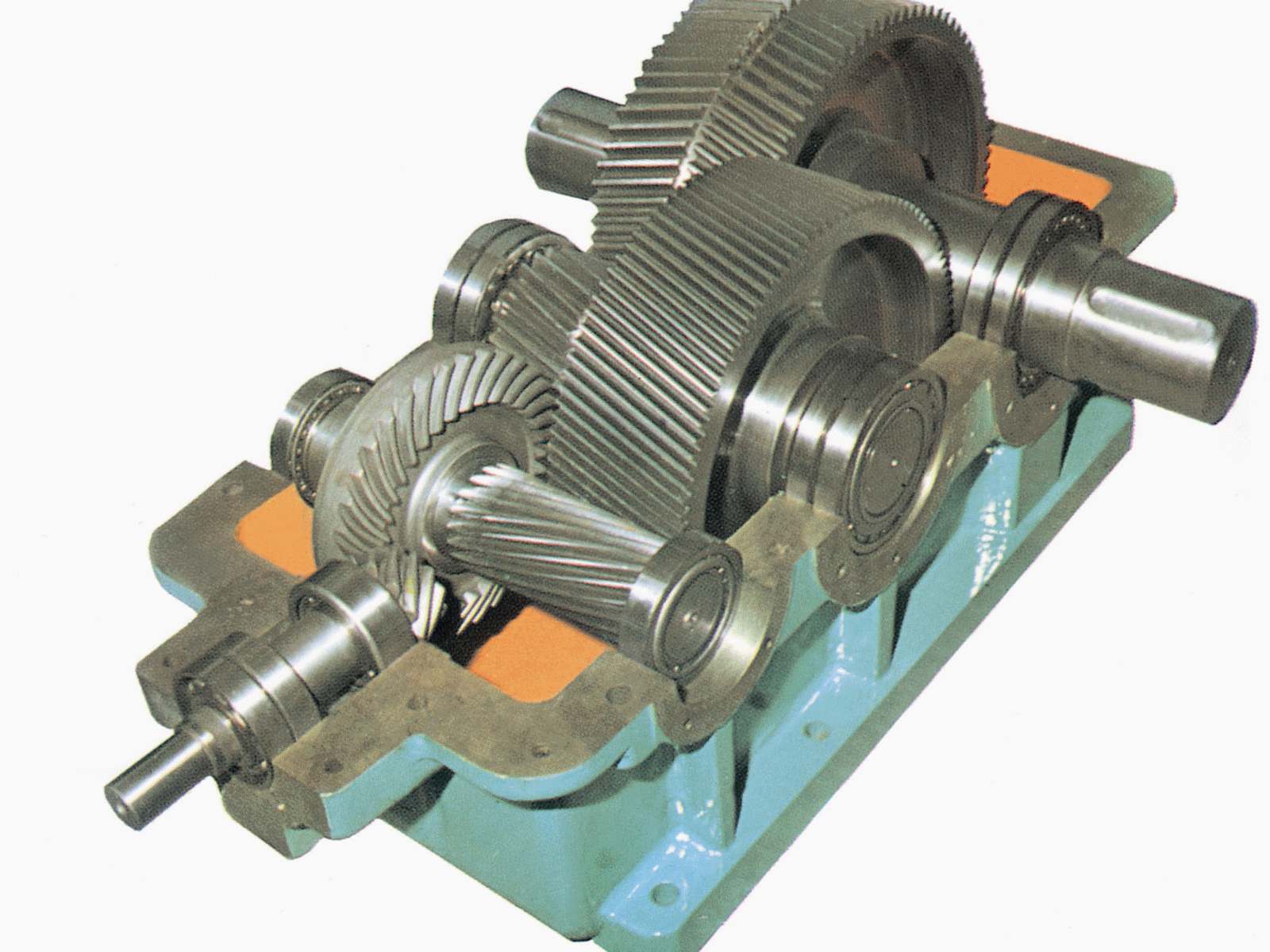
TSIRIKOS designs and manufactures custom industrial gearboxes – parallel-shaft and bevel-helical (right-angle) speed reducers – together with their gears, shafts and machined housings, and repairs and refurbishes existing gear units. Engineering, machining, heat treatment and assembly are carried out in our workshops in Piraeus, Greece.
Main applications
-
Conveyor drives
Learn more : Conveyor drivesGearboxes for belt conveyor lines, including conveyors in lignite mines, and their replacement gears and shafts.
-
Mills, crushers and mining equipment
Learn more : Mills, crushers and mining equipmentGear units and spare parts for mills, crushers, dryers, separators and other heavy processing equipment.
-
Cranes and port equipment
Learn more : Cranes and port equipmentGearboxes and wheels for port gantry cranes and other handling equipment.
-
Agitators, mixers and process plants
Speed reducers, shafts and agitator drives for chemical, petrochemical and other process plants.
-
Power plants
Learn more : Power plantsRepair of gearboxes, gears, shafts and bearings for steam, diesel and hydro power plants.
-
Plastics and recycling machinery
Learn more : Plastics and recycling machineryGearboxes for extruders and for crushing machinery in plastics processing and recycling.
Gearbox types and scope of work
-
Parallel-shaft (helical) gearboxes
Designed and built to suit each application in close cooperation with the customer, with horizontal or vertical offset arrangements, to ISO and DIN design standards.
-
Bevel-helical (right-angle) gearboxes
Right-angle gear units with a spiral bevel input stage followed by helical stages – new builds and rebuilds.
-
Planetary gear components and overhaul
Ring gears, planet gears and sun pinions to drawing, and overhaul of planetary gear units.
-
New planetary gearboxes
Complete new planetary gear units designed and built to the application.
-
Worm gearboxes
Complete worm reducers; worm gear sets for existing units are also manufactured.
-
Gearbox components
Learn more : Gearbox componentsGears, pinion shafts, shafts and machined housings for new gearboxes or as spare parts for existing units.
-
Repair and refurbishment
Learn more : Repair and refurbishmentInspection, dismantling, damage assessment, replacement of worn parts, reassembly and functional check of industrial gearboxes.
-
Shaft replacement
New shafts made to the original dimensions, or repair of worn journals by grinding, welding or metallizing followed by final grinding.
-
Gear replacement
New gears or gear pairs, or a new toothed rim fitted to an existing gear body.
-
Technical assessment and recalculation
Review of the gearbox design and recalculation of gears for the actual duty, with proposals for upgrades where a failure has recurred.
Gearbox types
An industrial gearbox (speed reducer) adapts the speed and torque of a motor to the driven machine. The right type depends on the shaft arrangement, the ratio, the torque and the space available. TSIRIKOS does not sell catalogue units: each gearbox is designed and built for its application, in close cooperation with the customer.
Parallel-shaft (helical) gearboxes
Input and output shafts are parallel and the reduction is made in one or more helical gear stages. Parallel-shaft units are robust, efficient and easy to service, which makes them the standard solution for conveyors, mills, mixers and many process drives. We design and build them with horizontal or vertical offset between the shafts, to ISO and DIN design standards.
Bevel-helical (right-angle) gearboxes
A spiral bevel stage turns the drive through 90°, followed by helical stages that provide the rest of the reduction. This arrangement allows the motor to sit alongside the driven machine – typical for conveyor drives and cranes. We manufacture bevel-helical units and their spiral bevel sets, and rebuild existing ones.
Planetary gear units
In a planetary stage the torque is shared by several planet gears running between a sun pinion and an internal ring gear. The result is a compact, coaxial unit with high torque density, used in heavy drives where space is limited. We manufacture planetary components – ring gears, planet gears and sun pinions – and overhaul planetary gear units.
Worm gearboxes
A worm and worm wheel give a high ratio in a single, compact right-angle stage, with lower efficiency than helical gearing. For worm reducers we manufacture replacement worm gear sets; ask us about complete units.
Selection considerations
Nominal power and ratio are only the starting point. When a gearbox is specified or recalculated, we look at:
- Service factor – starts per hour, shock loads and daily operating hours. A crusher or a mill drive needs far more margin than a uniformly loaded conveyor.
- Peak and starting torque – motor starting torque, braking and blockage loads can exceed the nominal torque several times.
- Thermal capacity – a gearbox that is mechanically adequate may still overheat in continuous duty or in hot, dusty surroundings; oil coolers or a larger housing may be needed.
- External shaft loads – overhung loads from chain or belt drives and axial loads on the output shaft determine bearing sizes.
- Mounting and lubrication – the mounting position decides oil levels, splash or forced lubrication and the sealing arrangement.
Gearbox components
The components of a gearbox determine its life. We manufacture them individually, for new units or as spare parts:
- Gears and pinion shafts – spur, helical, double-helical and spiral bevel, case-hardened and ground where specified. See industrial gears.
- Shafts – input, intermediate and output shafts, solid or hollow, with keyways or splines. See shafts and pinion shafts.
- Housings – bearing bores, split faces and bolt holes machined on a CNC horizontal machining centre; see precision CNC machining.
- Bearings – selected for the calculated loads and speeds; during overhaul, bearings are replaced to the original designation or an agreed equivalent.
Manufacturing and assembly
Design, machining, heat treatment, gear grinding and assembly are carried out on one site. During assembly, each gear stage is checked for correct meshing and contact pattern before the housing is closed, and the unit receives a functional check. Where the application requires it, a load test monitors lubricant and bearing temperatures and noise.
Repair, refurbishment and replacement parts
For a gearbox that is already in service, a typical refurbishment covers:
- Inspection – sealing, breather, tooth condition, bolted connections and contamination of the housing.
- Technical assessment – dismantling, damage analysis and identification of the root cause (overload, lubrication, misalignment, wear).
- Gear replacement – new gears or gear pairs, or a new toothed rim on an existing gear body.
- Shaft replacement – new shafts, or repair of journals by welding or metallizing followed by grinding.
- Housing repair – repair of damaged housings by welding, followed by machining where needed.
- Reassembly and check – gear-mesh check, closing and functional check, with a maintenance report for every repaired gearbox.
The full procedure is described on our gearbox repair and overhaul page. If you are weighing a repair against a new unit, our guide Gearbox repair or replacement sets out the technical criteria.
Information for a gearbox quotation
For a new gearbox, the essential data are power, input speed, ratio, output torque, mounting position, shaft arrangement, duty and ambient conditions. For a repair or a replacement part, the nameplate data, photos of the unit and a description of the failure are the best starting point. Request a quote with the data you have; we will ask for anything missing.
Manufacturing approach
-
Technical assessment
Duty, power, speeds, ratio, mounting and environment are reviewed; for existing units, the gearbox is inspected and the cause of failure identified.
-
Design and calculation
Gear and gearbox design by our design department, considering loads and peaks, inertia, lubrication, mounting, noise, temperature, vibration and backlash.
-
Component manufacture
Gears and shafts are turned, cut, heat-treated and ground in-house.
-
Housing machining
Gearbox housings are machined on a CNC horizontal machining centre: bearing bores, split faces, drilling and threading.
-
Bearing selection
Bearing types and fits are checked against loads and speeds; replacement bearings are specified to the original designation or an agreed equivalent.
-
Assembly
Assembly by our assembly department, with gear-mesh and contact-pattern checks before the housing is closed.
-
Functional check and load test
Functional check after assembly; where required, a load test checks lubricant and bearing temperatures and noise.
Quality considerations
-
Gear-mesh and contact-pattern check
The meshing of every gear stage is checked during assembly.
-
Component inspection
Dimensional, hardness, roughness and tooth-form inspection of gears and shafts before assembly.
-
Maintenance report
Every repaired gearbox is documented: gearbox type and serial number, work carried out, parts replaced or repaired.
-
Lubricant disposal
Used lubricant removed from gearboxes is disposed of through an authorised recycling body.
-
Back-to-back gearbox test rig
Gearbox testing by the back-to-back method with vibration, temperature, sound and oil-cleanliness monitoring, at test powers up to 9000 kW.
-
On-site inspection
Inspection of gearboxes at the customer’s plant, in Greece or abroad.
Representative images
-
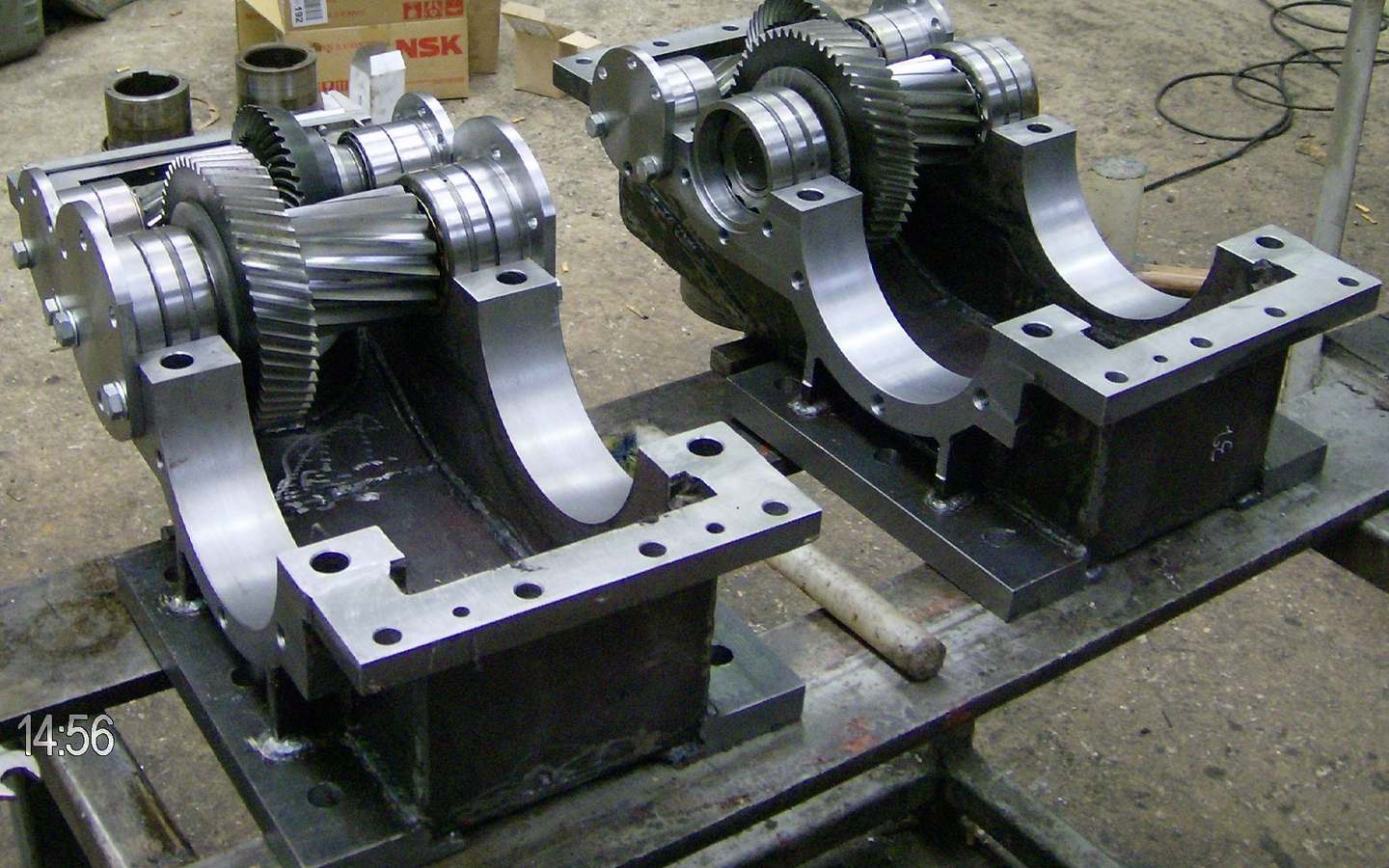
Two welded gearbox housings with spiral bevel and helical gear trains during assembly in the workshop -
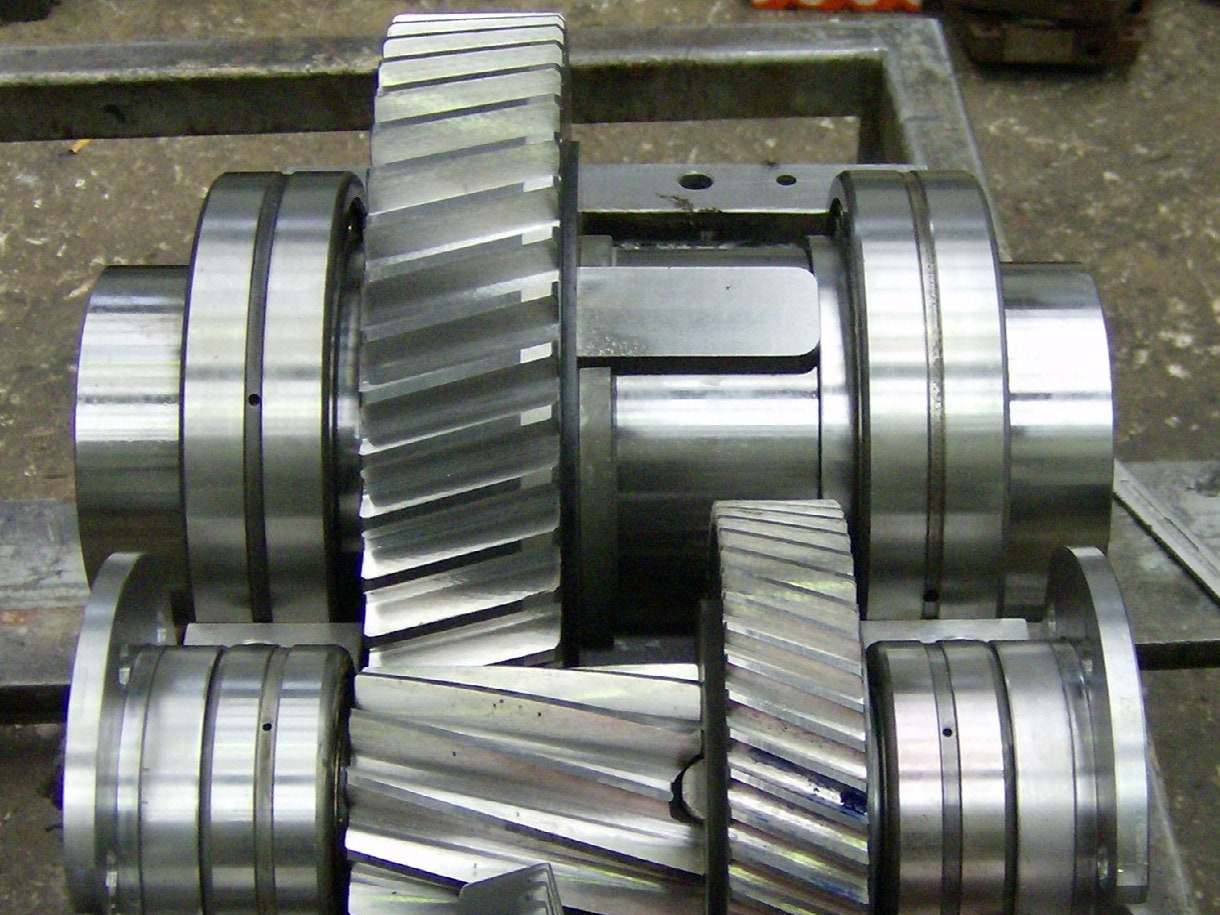
Bevel-helical gearbox with cover removed, showing helical gears, pinion shafts and bearings during assembly -
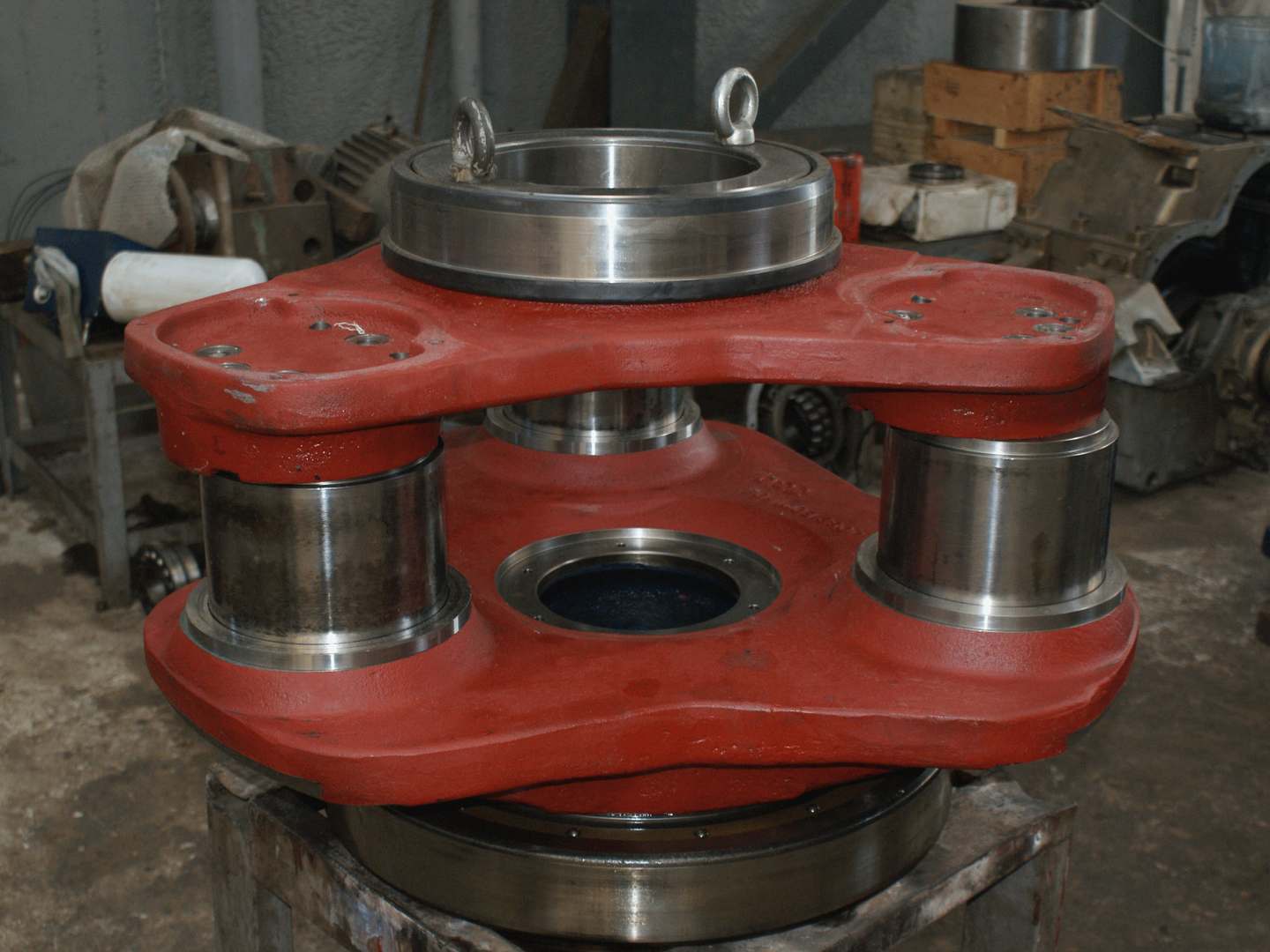
Cast planet carrier with bearings on a stand during planetary gearbox overhaul -
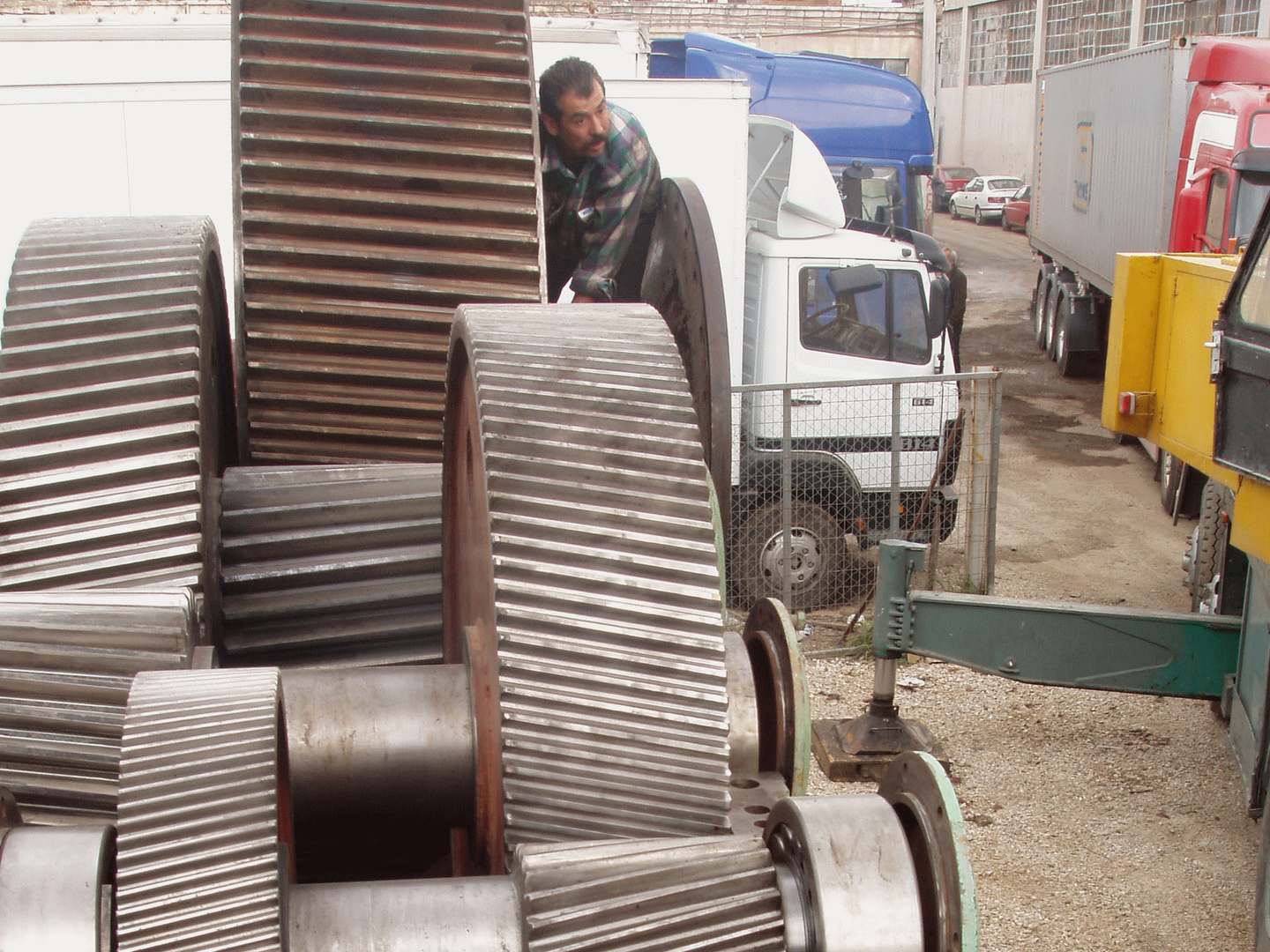
Disassembled heavy industrial gearbox with helical and bevel gear stages
Technical FAQ
Do you sell standard catalogue gearboxes?
No. Every gearbox is designed and built for a specific application, in close cooperation with the customer. That is why the duty data – power, speeds, ratio, mounting and environment – are the starting point of every quotation.
Can you replace a single gear or shaft in an existing gearbox?
Yes. We manufacture the replacement gear, gear pair or shaft to the original dimensions or to an improved specification. Depending on the damage, a worn shaft can also be repaired by welding or metallizing and grinding, and a gear can receive a new toothed rim.
Do you repair gearboxes made by other manufacturers?
Yes. We inspect, repair and overhaul industrial gear units from other manufacturers, including planetary units. Feasibility and scope are decided after inspection of the gearbox and, where possible, of the original data.
How is a gearbox checked after repair?
After reassembly, the gear mesh is checked and the unit undergoes a functional check. Where required, a load test monitors lubricant and bearing temperatures and noise. A maintenance report records the work done and the parts replaced.
Can a gearbox be upgraded during refurbishment?
Often, yes. When gears fail repeatedly, a recalculation may show that a different material, heat treatment, case depth or bearing arrangement gives more margin within the same housing. Any change is agreed with you before manufacture.
How is the delivery time of a gearbox defined?
Delivery time and commercial terms are stated in each written quotation, because they depend on the scope of work, the materials and the heat treatment required. For a repair, the scope is only known after inspection of the unit.
Related pages
Request for quotation — Gearboxes & Speed Reducers
Custom parallel-shaft and bevel-helical gearboxes, planetary gear components, gearbox parts, and repair, refurbishment and upgrading of existing industrial gear units.
Please attach your technical drawings and specifications to your email.