
Products
Shafts, Pinion Shafts and Splined Shafts
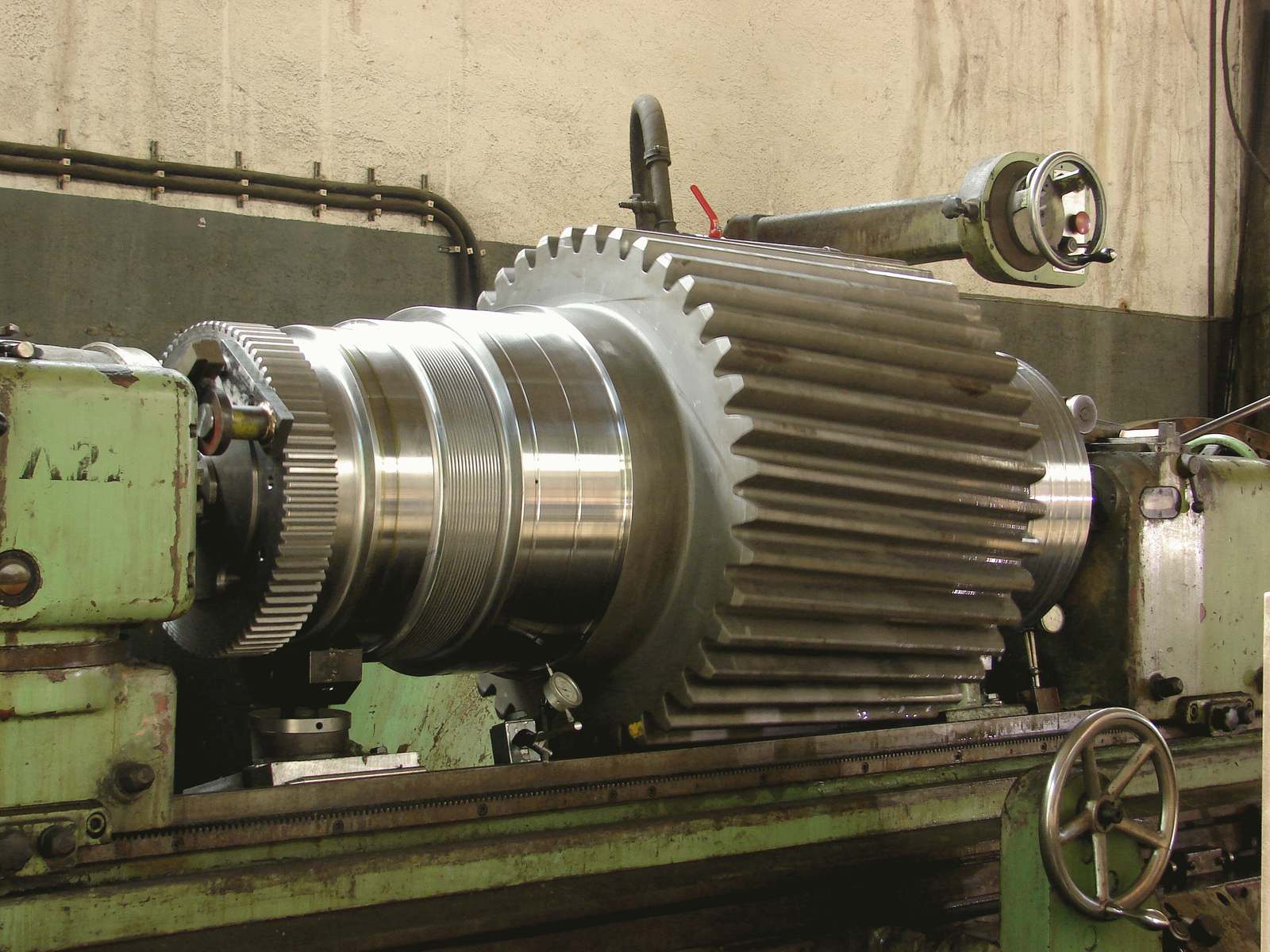
TSIRIKOS manufactures shafts and pinion shafts to customer drawings or samples: plain and stepped shafts, gear shafts with integral teeth, splined shafts, worm shafts and long shafts, turned, cut, heat treated and ground in our workshop in Piraeus, Greece.
Main applications
-
Gearbox shafts
Learn more : Gearbox shaftsInput, intermediate and output shafts and pinion shafts for new and repaired speed reducers.
-
Replacement pinion shafts
Learn more : Replacement pinion shaftsPinion shafts remade for industrial gear drives when the original part is worn, broken or no longer available.
-
Pump and compressor shafts
Learn more : Pump and compressor shaftsDrive shafts and rotor shafts for pumps and compressors in plants and ship machinery.
-
Rolls and long shafts
Learn more : Rolls and long shaftsRolls and long shafts for metal-forming and process lines, with journals ground after machining.
-
Rolling-stock and vehicle shafts
Learn more : Rolling-stock and vehicle shaftsShafts and gear shafts supplied as spare parts for railway vehicles and mobile machinery.
Shaft types we manufacture
-
Plain and stepped shafts
Shafts with bearing journals, seats, shoulders, keyways and threads, made to drawing or measured from a sample.
-
Pinion shafts (gear shafts)
Shafts with integral spur, helical or spiral bevel teeth, case-hardened and ground where specified.
-
Splined shafts
External splines on shafts and matching internal splines in hubs and gears, involute or straight-sided.
-
Worm shafts
Single- and multi-start worms, thread-cut and ground, supplied with or without the mating worm wheel.
-
Long shafts and rolls
Long shafts and rolls whose journals and seats are finished by cylindrical grinding.
-
Maximum shaft dimensions
Shafts up to about 4 m long.
Shafts made to your drawing or sample
TSIRIKOS does not sell catalogue shafts. Every shaft is made to the customer’s drawing or, when no drawing exists, from the original part. Typical work covers input, intermediate and output shafts for gearboxes, pinion shafts with integral teeth, splined shafts, drive shafts for pumps and plant machinery, and long shafts and rolls that need accurate journals over their full length.
A shaft is rarely a stand-alone part. It carries gears, bearings, seals and couplings, and its accuracy decides how all of them run. For that reason shafts are often made together with the mating industrial gears, or as part of a gearbox repair and overhaul.
Pinion shafts (gear shafts)
A pinion shaft has its teeth cut directly into the shaft body instead of on a separate gear. This is the usual design when the pinion is small compared with the shaft, when there is no room for a keyed or shrink-fit hub, or when the torque is too high for such a joint. We manufacture spur, helical and spiral bevel pinion shafts, then case-harden them and grind the teeth and bearing journals where the drawing requires it.
Splined shafts and hubs
Splines transmit torque through many teeth at once and, where needed, allow axial sliding. We cut external splines on shafts and internal splines in hubs and gears. The two common families are involute splines (for example DIN 5480 or ISO 4156) and straight-sided splines (ISO 14). The standard, module and fit are taken from your drawing or determined from the mating part.
Worm shafts, long shafts and rolls
Worms are thread-cut and then ground on a worm grinding machine, and can be supplied with the matching worm wheel. Long shafts and rolls need straightness and concentric journals over their whole length; grinding of long shafts and rolls is one of the grinding services we offer.
How a shaft is made
- Drawing review and material selection. Through-hardening steels such as 42CrMo4 or 34CrNiMo6 are common for shafts; case-hardening steels such as 18CrNiMo7-6 for heavily loaded pinion shafts.
- Turning, leaving allowance for heat treatment and grinding.
- Gear cutting, spline cutting, keyways and threads.
- Heat treatment in our own heat-treatment department: gas carburizing, nitriding, nitrocarburizing, induction hardening, or quenching and tempering.
- Grinding of journals, seats and, where specified, tooth flanks.
- Inspection of dimensions, runout, hardness and surface roughness.
Keeping machining, heat treatment and grinding in one place means the grinding allowance and the expected distortion are planned together from the start.
Points to check on a shaft drawing
These are general engineering points that often decide whether a shaft lasts:
- Fillet radii and undercuts. Most shaft fatigue failures start at a sharp shoulder, a keyway end or a groove. Generous radii help.
- Journal tolerances and roughness should follow the bearing manufacturer’s recommendation for the fit.
- Heat-treated zones. State which areas are hardened and which must stay soft, for example threads or areas to be drilled at assembly.
- Distortion and grinding allowance. Carburized shafts move during quenching; long, slender shafts need enough allowance on the ground diameters.
- Centre holes. Keep them if the shaft may be reground in the future.
Replacement and repaired shafts
When a shaft breaks or wears, there are two routes: a new shaft made from the drawing or measured from the old one, or repair of the existing part. Depending on the damage, journals can be restored by grinding, or by welding or metallizing followed by final grinding (see industrial mechanical repair). If there is no drawing, the shaft is measured and a drawing is prepared for your approval through our reverse engineering process.
What to send
Send the drawing (PDF, DWG/DXF or STEP) or photos of the old shaft with its main dimensions, the material and heat treatment if known, the quantity, the machine it belongs to and the delivery location. Use the request a quote page; we come back with technical questions where something is unclear.
Materials
-
Through-hardening alloy steels
For example 42CrMo4 (1.7225) and 34CrNiMo6 (1.6582), quenched and tempered, optionally nitrided or induction hardened.
-
Case-hardening steels
For example 18CrNiMo7-6 (1.6587) and 15CrNi6 (1.5919) for carburized pinion shafts.
-
Nitriding steels
For example 31CrMoV9 (1.8519) and 34CrAlNi7 (1.8550) where a hard, low-distortion surface is required.
-
Special-composition steels
Steels selected and imported to suit the application and the loads on the part.
The grade is taken from your drawing or agreed with you during the technical review.
Manufacturing approach
-
Drawing or sample review
Check of dimensions, tolerances, material and heat treatment; questions are raised before quoting.
-
Turning and rough machining
Turning with allowance left for heat treatment and grinding.
-
Gear, spline and thread cutting
Teeth, splines, keyways and threads are cut before heat treatment.
-
In-house heat treatment
Gas carburizing, nitriding, nitrocarburizing, induction hardening or quenching and tempering in our own department.
-
Grinding
Cylindrical grinding of journals and seats; tooth-flank or worm grinding where specified.
-
Final inspection
Dimensions, runout, hardness and surface roughness are checked before dispatch.
Quality considerations
-
Dimensional and geometric checks
Diameters with calibrated micrometers; concentricity, parallelism and ovality checked with precision instruments.
-
Hardness after heat treatment
Surface hardness measured on the treated zones.
-
Surface roughness
Roughness of journals and ground surfaces measured with a calibrated digital roughness tester.
-
Crack examination
Surface examination for micro-cracks after grinding and heat treatment.
-
Inspection documents
Learn more : Inspection documentsInspection documents to EN 10204 on request; type 3.2 requires an independent or customer inspector.
Representative images
-
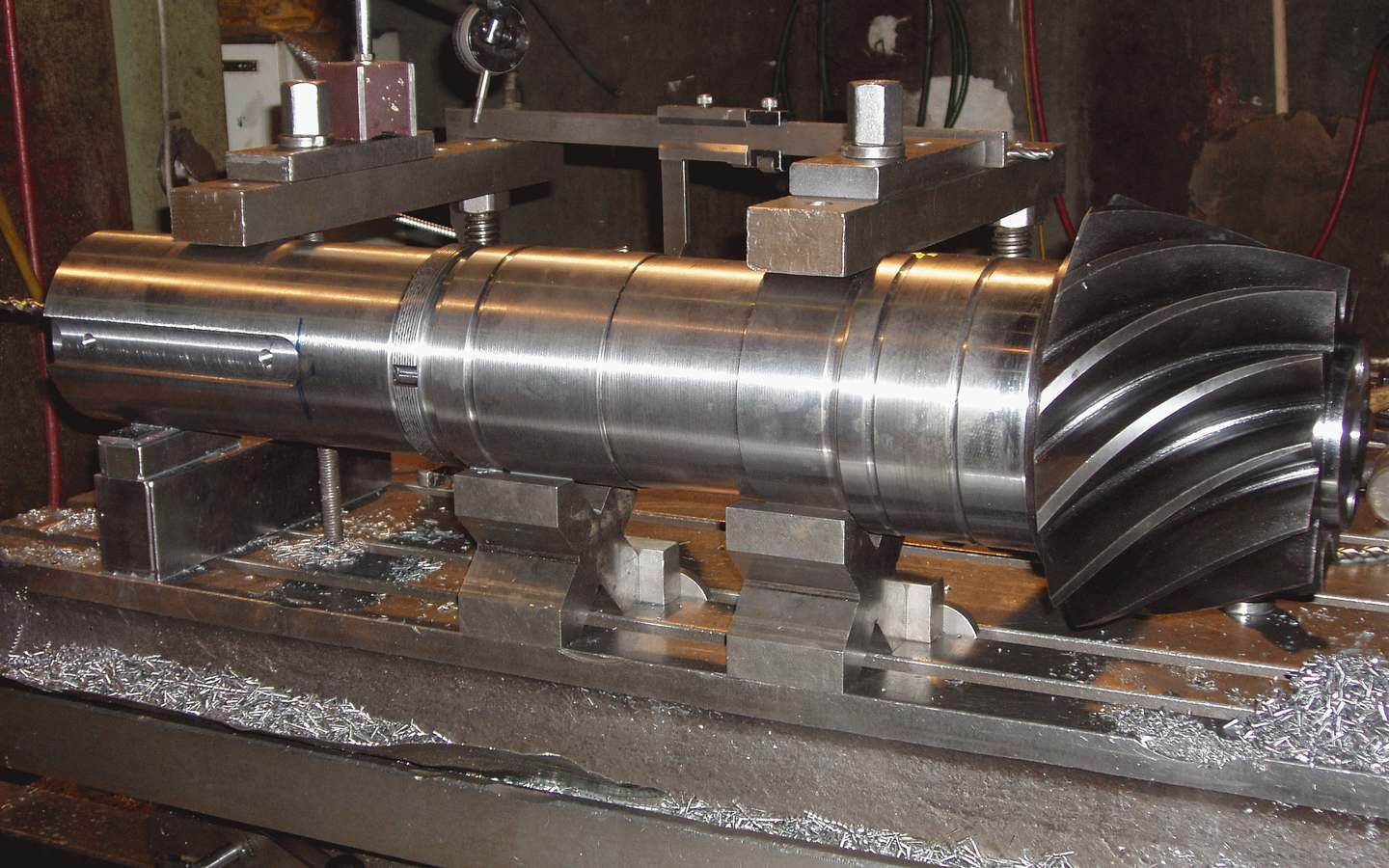
Spiral bevel pinion shaft clamped in V-blocks on a milling machine table -
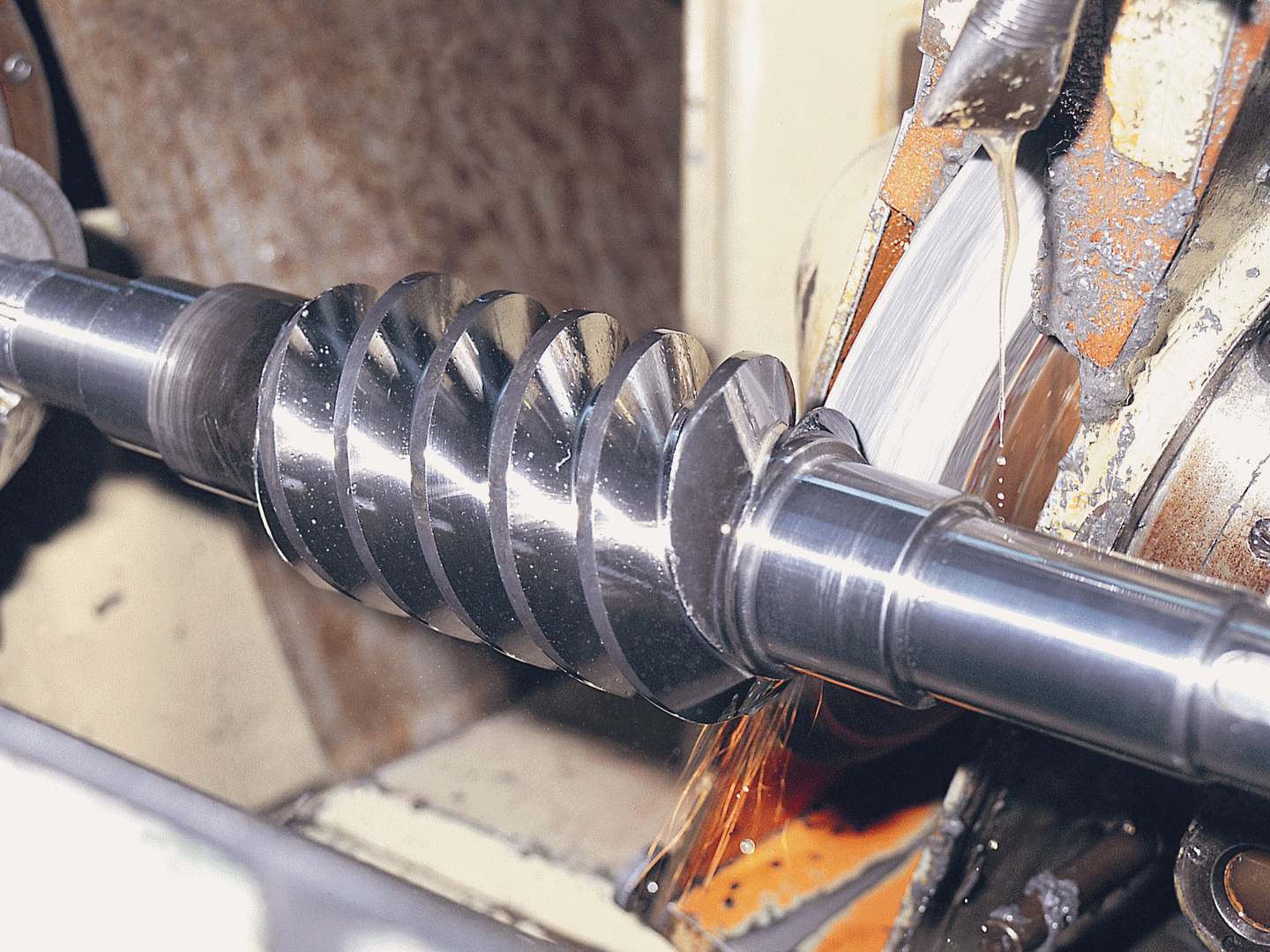
Worm shaft being ground on a thread grinding machine with coolant and sparks -
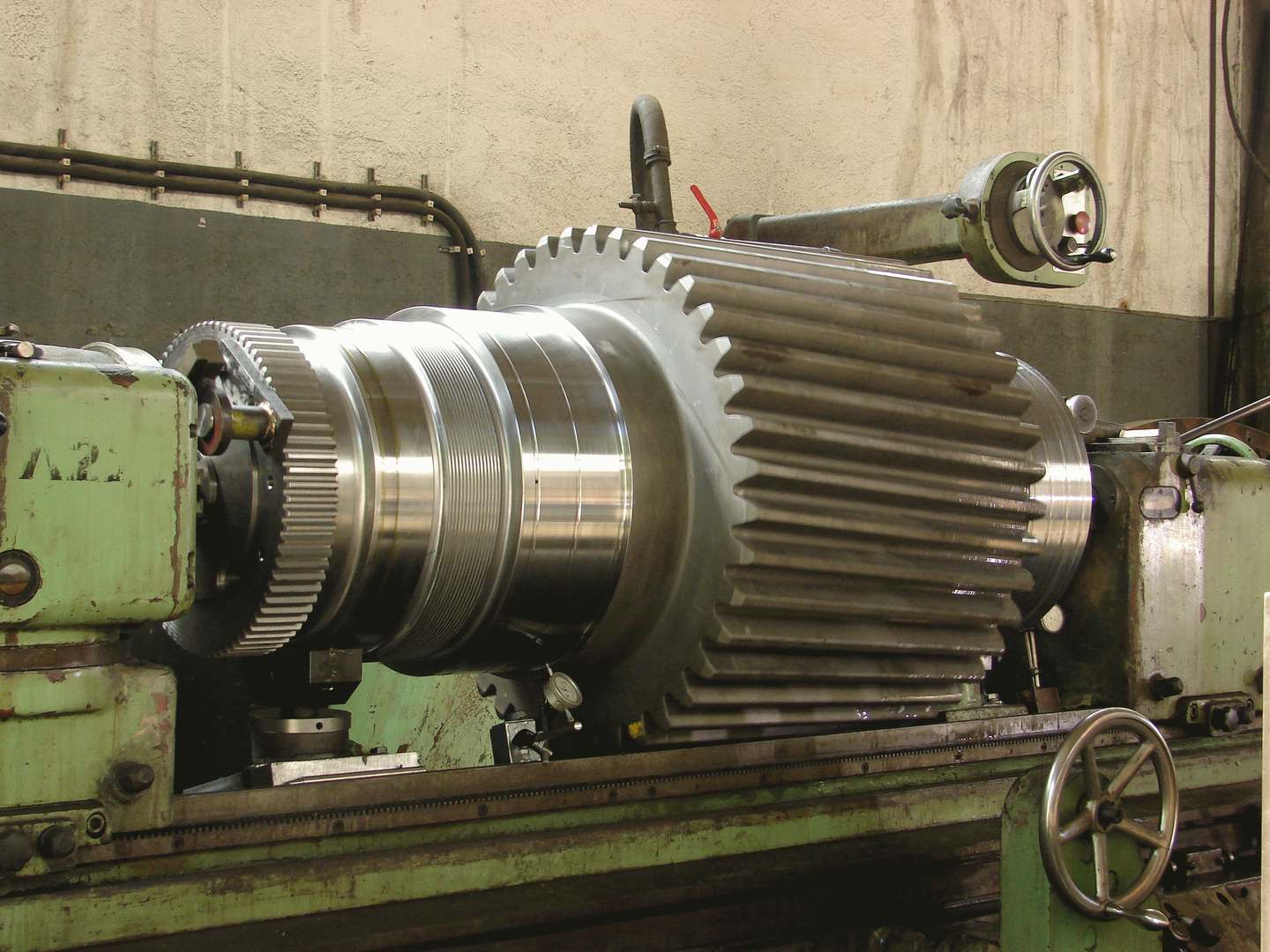
Large spur pinion shaft mounted on a cylindrical grinding machine for journal grinding
Technical FAQ
Can you make a shaft if we have no drawing?
Yes. Manufacturing from a sample is part of our normal work: the old shaft is measured, worn areas are reconstructed, and a drawing is prepared for your approval before production.
Is it better to repair or replace a worn shaft?
It depends on the damage. Worn journals can often be restored by grinding, or by welding or metallizing followed by grinding. A cracked or bent shaft, or one with damaged teeth, is normally replaced.
When should a pinion shaft be used instead of a separate gear on a shaft?
When the pinion diameter is close to the shaft diameter, when there is no room for a keyed or shrink-fit hub, or when the torque is too high for such a connection. The integral design removes one joint but means the whole part must be replaced if the teeth fail.
Which spline standards do you work to?
We cut splines to the standard on your drawing, typically involute splines (e.g. DIN 5480 or ISO 4156) or straight-sided splines (ISO 14). Note that DIN 5480 and ISO 4156 are not interchangeable.
Are the journals ground after heat treatment?
Yes, where tolerances or roughness require it. Bearing journals and seats are finished by cylindrical grinding after heat treatment, which also removes heat-treatment distortion.
What is the maximum shaft length you can produce?
We do not publish maximum dimensions on this page. Send your drawing or the main dimensions and we confirm feasibility for the specific shaft.
Related pages
Request for quotation — Shafts, Pinion Shafts and Splined Shafts
Shafts, pinion shafts, splined shafts and long shafts made to drawing or sample, with in-house gear cutting, heat treatment and grinding.
Please attach your technical drawings and specifications to your email.