
Products
Industrial Transmission Components
TSIRIKOS manufactures the mechanical components that connect and carry a drive: couplings, splined hubs and sleeves, pulleys, sprockets, bushes, large rings, worm wheels, Hirth couplings and threaded parts, made to drawing or sample in our workshop in Piraeus, Greece.
Main applications
-
Gearbox and drive-train repair
Learn more : Gearbox and drive-train repairCouplings, bushes, splined hubs and worm wheels replaced during the overhaul of a drive.
-
Conveyors and bulk handling
Learn more : Conveyors and bulk handlingSprockets, pulleys, rollers and couplings for conveyors, elevators and crushers.
-
Cranes and port equipment
Learn more : Cranes and port equipmentWheels, couplings and transmission parts for gantry cranes and port machinery.
-
Process and printing machinery
Learn more : Process and printing machineryTiming gears, rollers, shafts and drive parts for packaging, printing and plastics lines.
-
Construction, agricultural and rail equipment
Learn more : Construction, agricultural and rail equipmentBushes, gears, shafts and arms supplied as spare parts for mobile machinery and railway vehicles.
Components we manufacture
-
Couplings
Coupling hubs and sleeves, including gear-coupling sleeves with internal teeth, keyed or splined to the shafts.
-
Splined hubs and sleeves
Internal and external spline cutting on hubs, sleeves, gears and other power-transmission parts.
-
Pulleys
Pulleys machined to drawing or to the belt section and the existing shaft.
-
Sprockets and ratchet wheels
Chain sprockets and ratchet wheels, with hardened teeth where specified.
-
Hirth couplings
Face-toothed Hirth couplings for connecting shaft sections with precise centring.
-
Worm wheels and worms
Worm wheels, including multi-start and large-lead-angle wheels cut with a tangential head, and matching worms.
-
Bushes and rollers
Bushes, sleeves and rollers turned and ground to the fit of the mating parts.
-
Large rings
Turning and grinding of large-diameter rings and bearing rings (rolling bearings themselves are not manufactured).
-
Threaded parts
Thread and screw cutting on shafts, spindles and power-transmission screws.
-
Bearing housings and keys
Machined bearing housings and keys to standard or drawing.
Components that connect and carry the drive
Between the motor and the driven machine there are many parts that are not gears in the strict sense but decide whether the drive runs smoothly: couplings that join shafts, splined hubs that transmit torque while allowing axial movement, pulleys and sprockets that carry belts and chains, bushes and rings that guide and support. TSIRIKOS manufactures these components to customer drawings or from the original part, for new machines as well as for maintenance and repair.
Because we also make shafts and pinion shafts and industrial gears, a complete set of mating parts can be produced together so that fits are checked on the actual parts.
Couplings and splined connections
We make coupling hubs and sleeves, including gear-coupling sleeves with internal teeth, keyed or splined to the shafts. Spline cutting covers external splines on shafts and internal splines in hubs, sleeves and gears. When only one half of a coupling must be replaced, the new part is made to match the existing half.
Pulleys, sprockets and ratchet wheels
Pulleys are machined to the belt section and the shaft. Chain sprockets and ratchet wheels are cut to the chain or pawl, and their teeth can be hardened in our own heat-treatment department where wear is the main concern.
Bushes, rollers and large rings
Bushes, sleeves and rollers are turned and ground to the fit of the mating shaft or housing. We also turn and grind large-diameter rings, including bearing rings. Rolling bearings themselves are standard catalogue products and are not manufactured by us.
Worm wheels, Hirth couplings and threaded parts
Worm wheels are cut on our gear cutting machines; with a tangential head, multi-start and large-lead-angle wheels can be produced, together with the matching worm. Hirth couplings, with radial teeth on their end faces, connect shaft sections with precise centring. Thread and screw cutting is carried out for spindles, adjusting screws and other threaded transmission parts.
Selection notes
These general engineering points help when specifying a replacement component:
- Fits. Specify the ISO fit (for example H7/k6 for a hub on a shaft) or the interference for shrink-fitted parts. For a replacement, the fit of the old part on the existing shaft may be worn, so measuring the shaft matters as much as measuring the part.
- Keys or splines. Keyed joints are simple but concentrate stress at the keyway. Splines spread the load over many teeth and are preferred for high or alternating torque and for sliding connections.
- Material pairing. Worm wheels and plain bushes usually run against a harder steel partner. Sprockets are often hardened on the teeth to resist chain wear.
- Standards. Chains (e.g. ISO 606), splines (DIN 5480, ISO 4156, ISO 14) and keys (e.g. DIN 6885) follow standards; naming the standard on the drawing avoids guesswork.
Making parts that fit an existing machine
A replacement component must fit parts that have already been in service. When there is no drawing, the old part and, where possible, its mating part are measured, worn surfaces are reconstructed and a drawing is prepared for your approval. This is the same method we use for manufacturing from drawings and for reverse engineering of spare parts.
What to send
Send the drawing or photos of the part with its main dimensions, the data of the mating parts (shaft diameter, keyway or spline, chain or belt), the material and heat treatment if known, the quantity and the delivery location through the request a quote page.
Materials
-
Carbon and alloy steels
Low-, medium- and high-carbon and alloy steels, heat treated to the required hardness.
-
Stainless steels
For components exposed to water, chemicals or food contact.
-
Copper alloys
Copper and brass for bushes and sliding parts.
-
Bronze worm-wheel rims and bushes
Bronze grades for worm-wheel rims and plain bushes.
-
Engineering plastics
PTFE (Teflon) for selected sliding or insulating parts.
Material and hardness are chosen to suit the mating part: for example a hardened steel worm against a softer wheel, or a sprocket hardened against chain wear.
Manufacturing approach
-
Review of the drawing or sample
Fits, mating dimensions and standards are checked; the mating part is measured where needed.
-
Turning, boring and milling
Hubs, bores, faces, keyways and profiles on lathes, boring mills and machining centres.
-
Gear and spline cutting
External and internal teeth and splines, sprocket and ratchet profiles.
-
Heat treatment
Carburizing, nitriding, induction hardening or quenching and tempering in our own department.
-
Grinding
Internal and external cylindrical grinding of bores, seats and rings; surface grinding of faces.
-
Inspection
Fits, runout, hardness, roughness and tooth form are checked before dispatch.
Quality considerations
-
Fits and bores
Bores, seats and spline fits checked against the drawing and the mating part.
-
Runout and concentricity
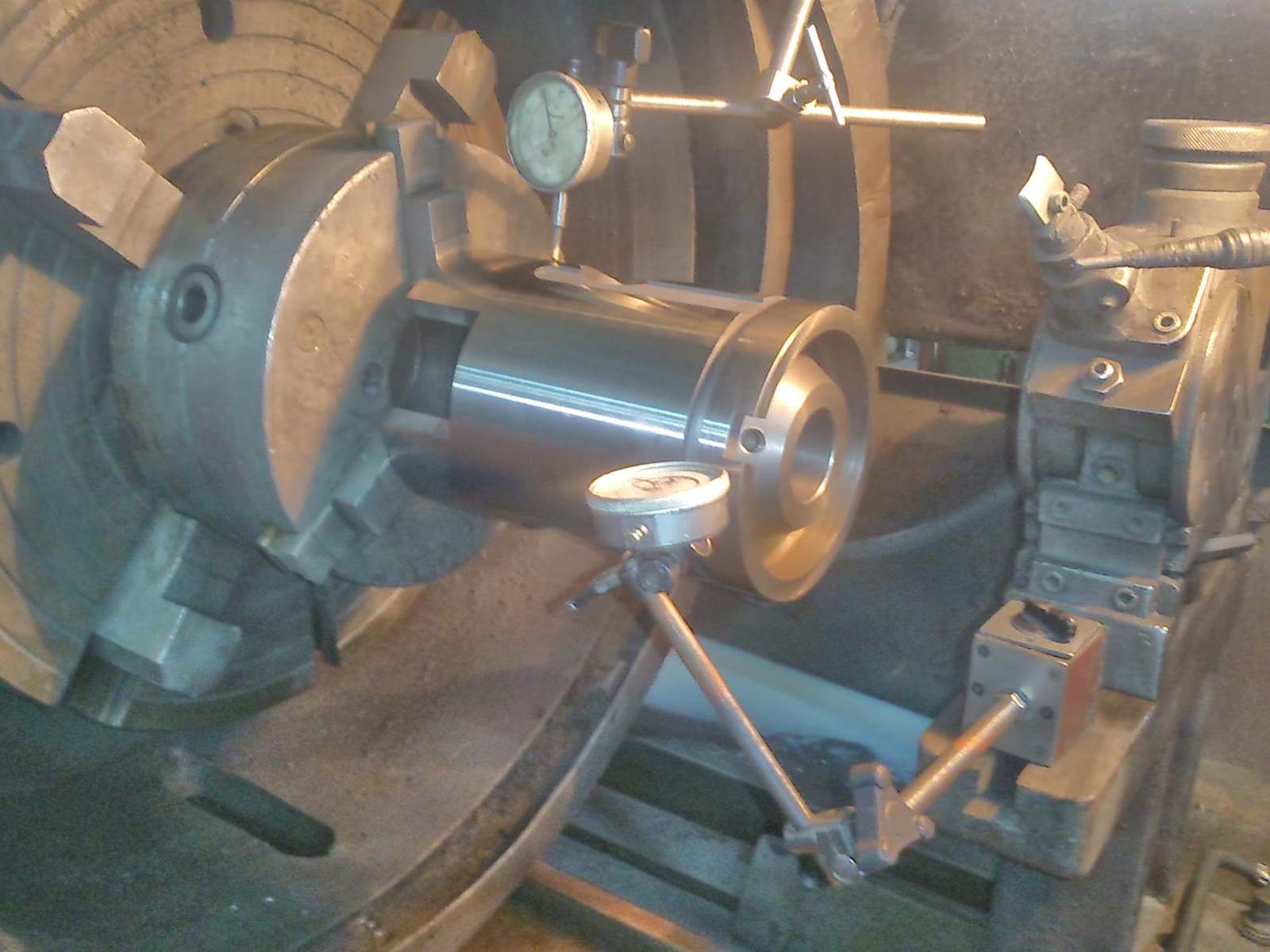
Concentricity and parallelism of hubs, rings and bushes checked with precision instruments.
-
Hardness and crack examination
Hardness measured after heat treatment; surfaces examined for micro-cracks.
-
Tooth form
Learn more : Tooth formTooth form inspection on toothed components such as worm wheels and coupling sleeves.
Representative images
-
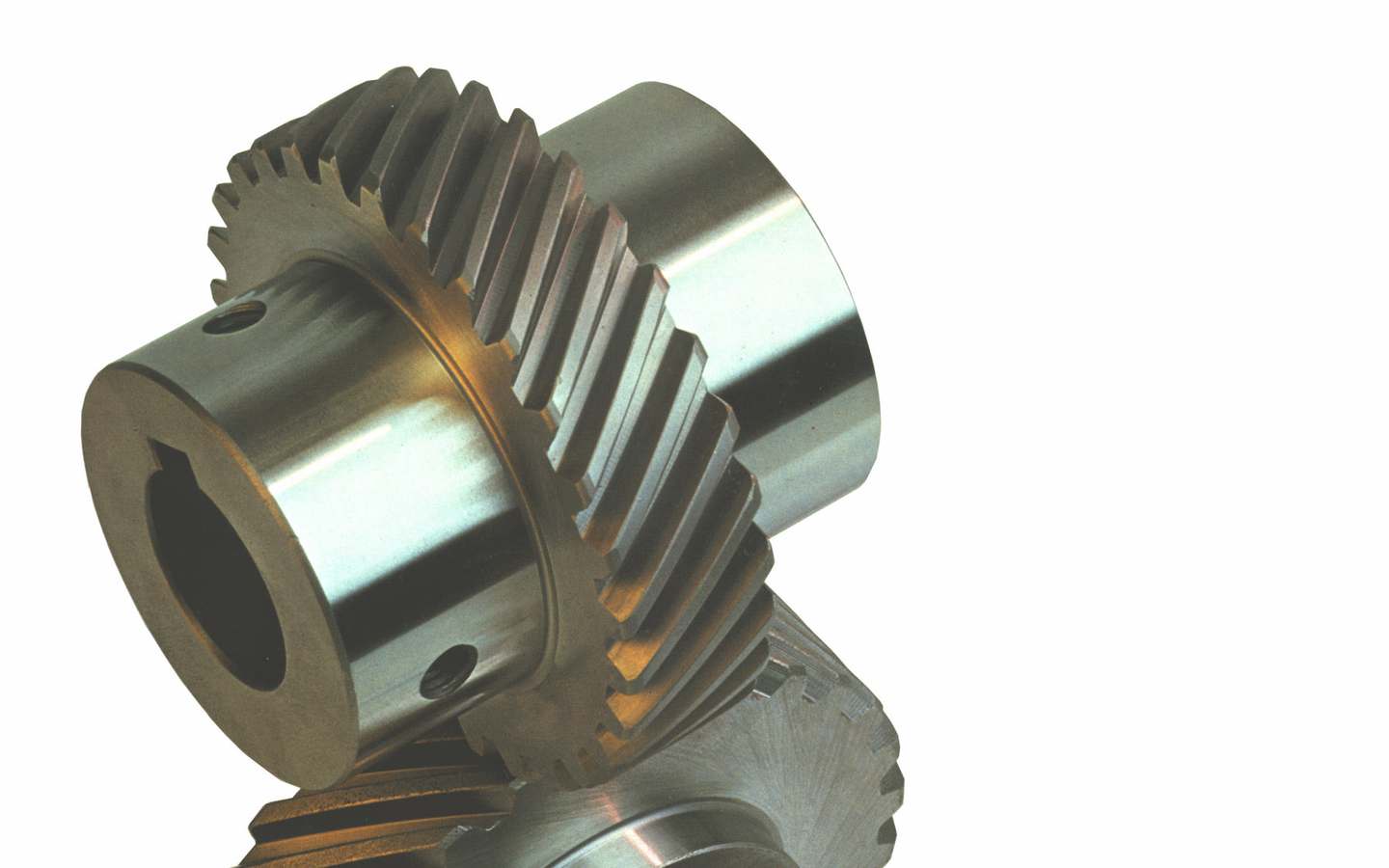
Pair of crossed helical gears with keyed hub and slotted shaft -
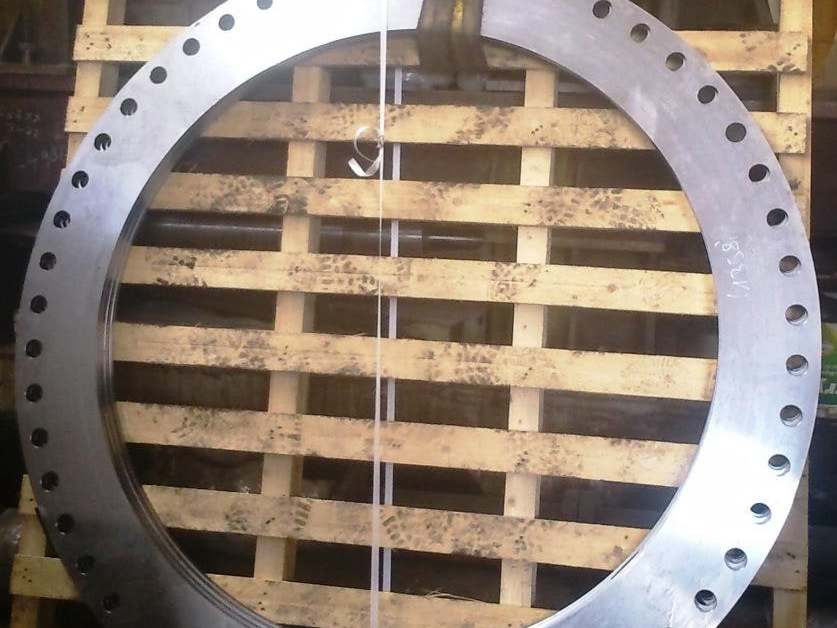
Large machined steel ring with bolt-hole circle hanging from a crane sling -
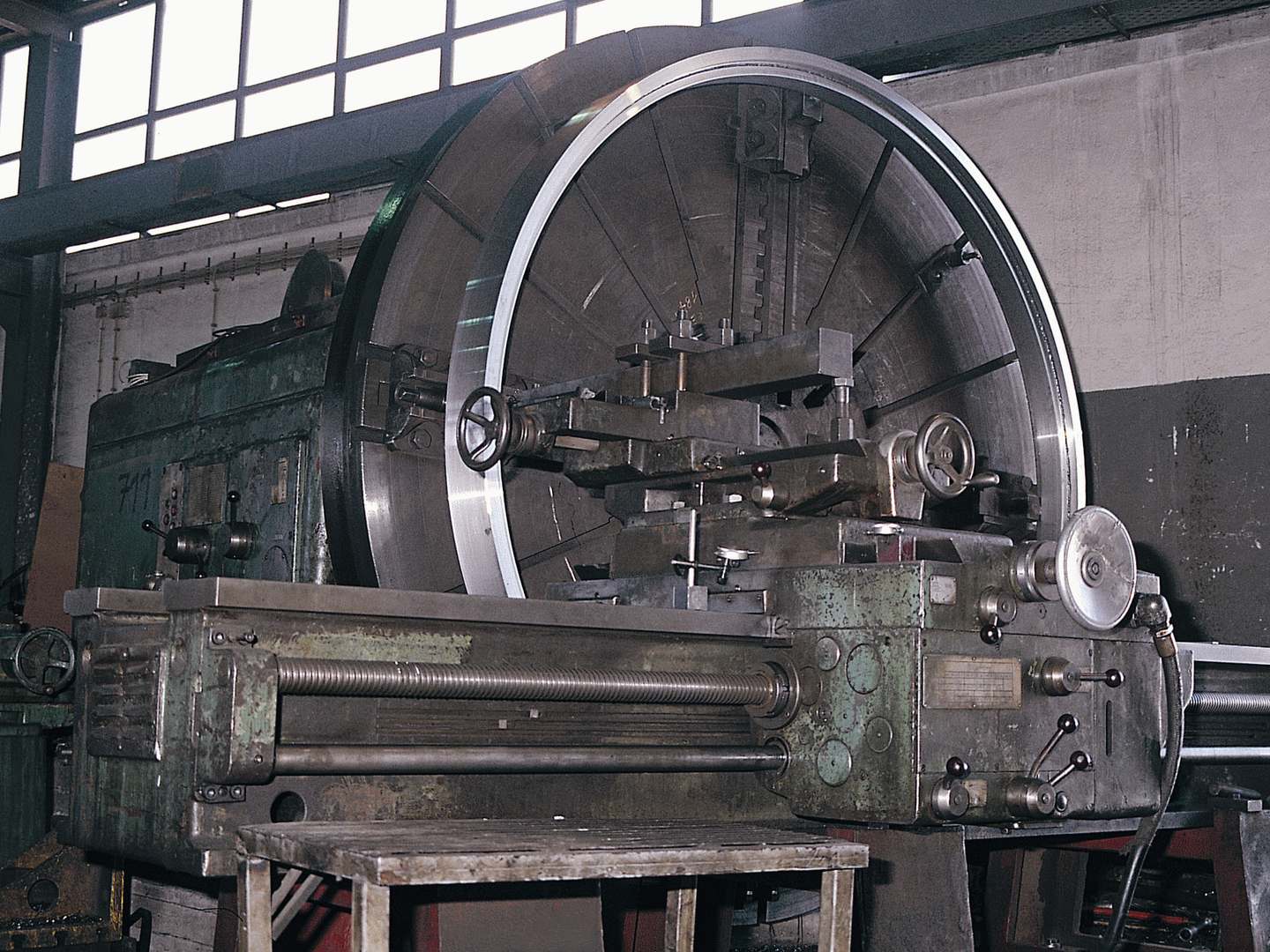
Large steel ring clamped on the faceplate of a heavy facing lathe
Technical FAQ
Do you manufacture rolling bearings?
No. We machine bushes, sleeves and large rings and grind large-diameter bearing rings, but rolling bearings themselves are standard products from bearing manufacturers. In repairs, worn bearings are replaced.
Can you make a gear-coupling sleeve to match an existing hub?
Yes. The internal teeth of the sleeve are made to match the hub: we need the hub drawing or the hub itself (or the old sleeve) to determine module, number of teeth and profile.
What data do you need for a chain sprocket?
The chain standard and size (e.g. ISO 606 roller chain, pitch and roller diameter), the number of teeth, single or multiple strand, the bore and keyway, and whether the teeth must be hardened.
What is a Hirth coupling used for?
A Hirth coupling connects two shaft sections or a shaft and a disc through radial teeth on their end faces. It centres the parts precisely and transmits high torque in a compact space, which is why it is used in turbines, indexing tables and built-up crankshafts.
Do you cut internal splines as well as external ones?
Yes, spline cutting covers internal and external splines on hubs, sleeves, gears and shafts, to the standard given on the drawing.
Related pages
Request for quotation — Industrial Transmission Components
Couplings, splined hubs, pulleys, sprockets, bushes, rings, worm wheels and Hirth couplings made to drawing or sample to fit your existing drive.
Please attach your technical drawings and specifications to your email.